One rail, rubber tyres, two kinds of power
A TVR could follow a rail like a tram or leave it and drive like a bus. Here is how.
TVR stands for Transport sur Voie Réservée, French for “transport on a reserved track”. It was a tram on rubber tyres. French government report, 2010
It was sold as something in between a bus and a tram: a tram’s qualities when guided, an articulated bus’s freedom when it left the rail. French government report, 2003
Technically it was an articulated road vehicle on four axles, each with guidance that could be disengaged. French government report, 2003
Following the rail
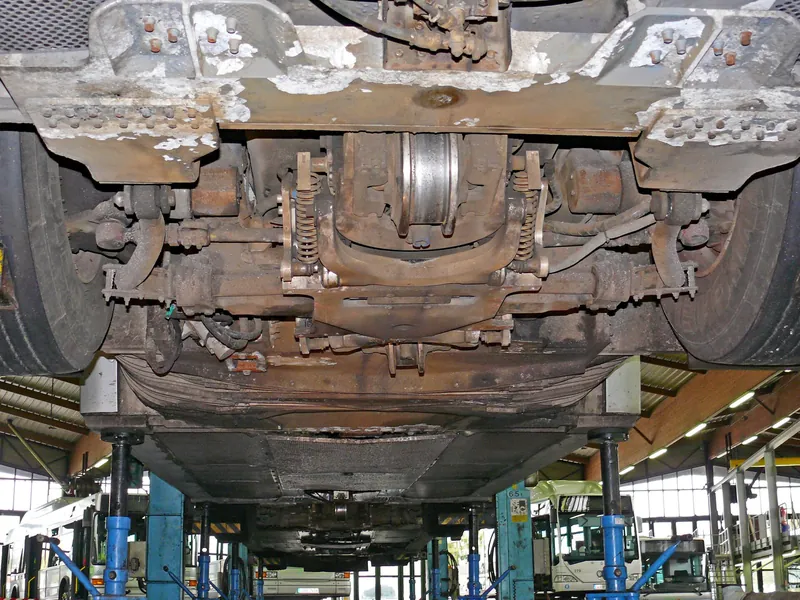
Each axle had a frame at the front and the back, ending in a grooved roller that ran along the central rail, pressed down by air and steel springs with a force of about 70 kN. French government report, 2003
The front roller was joined to the steering. As it followed the rail into a curve, it turned that axle’s wheels. French government report, 2003
The rear roller on each axle could slide sideways, up to a stop. French government report, 2003
On the guide rail every axle followed the same path, so the long vehicle needed less room on corners. CBW magazine, 2023
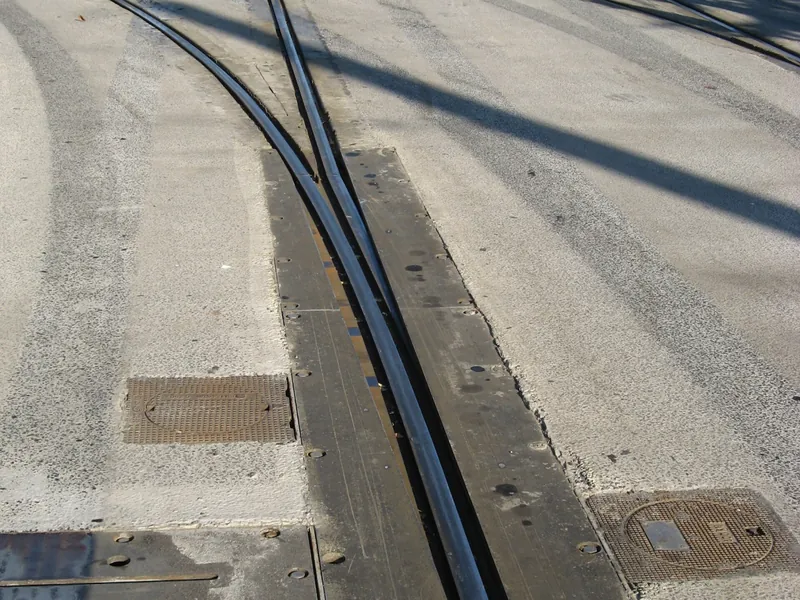
Leaving the rail
In road mode, rams between the three body sections had to lock into place automatically, so that the long vehicle still followed a single track. French government report, 2003
Every working day started and ended in road mode: out of the depot, onto the guide rail, back and forth along the line, then off the rail and back to the depot. French government report, 2010
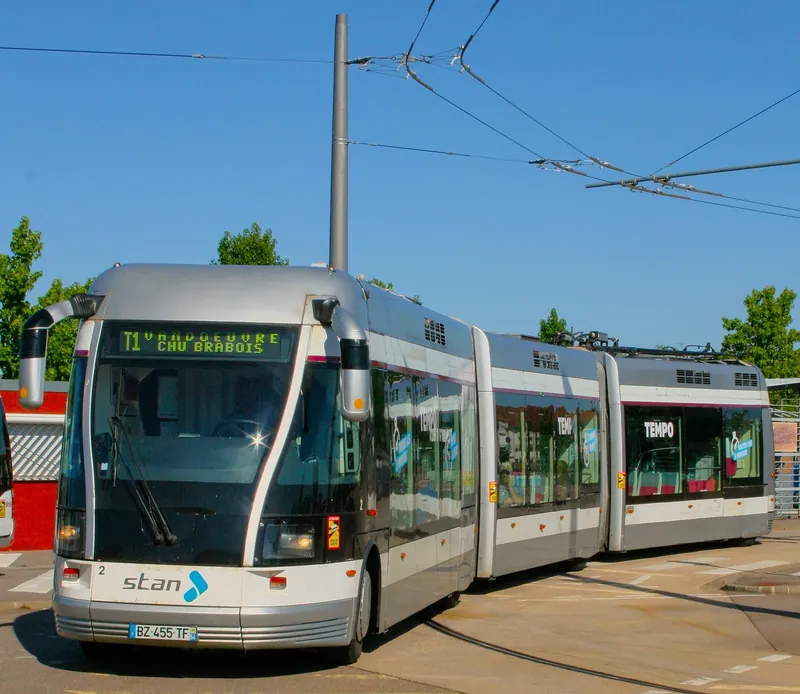
Nancy’s route had a 3 km section with no guide rail, where drivers steered; vehicles joined or left the rail at Callot. Railway Gazette In Nancy each vehicle also left and rejoined the rail twice on every trip, about ten times a working day. French government report, 2010
Two kinds of power
It also had two kinds of power: electric and diesel. French government report, 2003
The two cities fed power to their TVRs differently: Nancy’s took current like a trolleybus, Caen’s like a tram. French government report, 2010
Nancy’s line had a two-wire overhead line at 750 volts DC. Railway Gazette
In both cities the vehicles carried a generator set, so they could move under their own power away from the wires. French government report, 2010
How does a diesel engine make power in the first place? Our sister site explains petrol and diesel engines.
Size and shape
| Length | Each TVR was 24.5 metres long. French government report, 2003 |
|---|---|
| Width | It was 2.4 metres wide, wider than the 2.2-metre Translohr. French government report, 2010 |
| Axles | Technically it was an articulated road vehicle on four axles, each with guidance that could be disengaged. French government report, 2003 |
Nancy’s steep gradients were one reason it chose the TVR. CBW magazine, 2023
Next: what happened to it →