From a Belgian test track to two French cities
The TVR began as a Belgian idea, was tested near Paris, and went into service in Nancy and Caen within two years of each other.
Not the sports car. This TVR is not the British sports-car maker, and nothing to do with the old Taff Vale Railway. It is the French Transport sur Voie Réservée, a guided tram on rubber tyres that ran in Nancy and Caen.
A Belgian idea
The TVR was not invented by Bombardier. The idea came from the Belgian firm La Brugeoise et Nivelles, which Bombardier bought. French government report, 2010
Feasibility trials began on the Ursel test circuit in Belgium in 1980, and a prototype was shown at the UITP congress in Brussels in 1985. French government report, 2003 The 1985 prototype was called the GLT, for Guided Light Transport. The French reports use GLT and TVR for the same system. French government report, 2010
The 2003 expert report files Bombardier’s guidance papers under the heading “Guidage du GLT (TVR)”. French government report, 2003
Two pre-production vehicles built in 1987 were tried on a 3.2 km test line at Rochefort, in Belgium, until 1995. Noise, fast wear of the guide roller and a swaying ride all needed work. French government report, 2003
Tested near Paris
The French state backed these new “intermediate” vehicles with research money, and had the Paris transport operator RATP test three of them, Civis, Translohr and TVR, on part of the Trans-Val-de-Marne busway. French government report, 2010
On that busway, between Saint-Maur and Chevilly-Larue, 1.5 km was given a central rail. There the TVR ran guided and electric, under an overhead wire with the current returning through the rail; on the rest of the route it ran as a road vehicle on its diesel-electric engine. The trials ran on and off between November 1997 and December 1999. French government report, 2003
For comparison, a standard French steel-wheeled tram cost about 17 million francs a vehicle in the early 1990s. French government report, 2010
Caen orders, Nancy opens
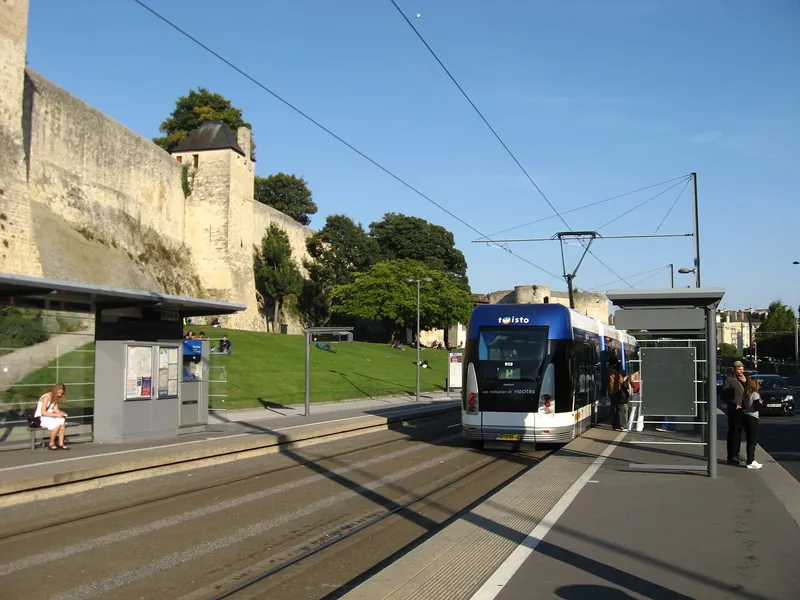
Caen was the first city in France to order a TVR. Its first line was let as a concession in 1994. French government report, 2003
Nancy ordered the TVR next, but opened first. French government report, 2003
Railway Gazette describes Nancy’s line as a guided, rubber-tyred trolleybus route, opened in December 2000 and serving 28 stops. Railway Gazette
Nancy’s line was inaugurated in December 2000 and began carrying passengers in February 2001. French government report, 2003
After about six weeks it was stopped. Switching from guided to road mode was not working properly: the links meant to keep the vehicle on a single track did not lock in place, and the driver was not always warned. French government report, 2003 The prefect of Meurthe-et-Moselle halted the service, and it restarted a year later, in March 2002, after changes to the vehicles. French government report, 2003
Caen’s TVR began carrying passengers in November 2002. French government report, 2003
A rocky start
In a single week in November 2002 there were four losses of guidance and other worrying faults on the Nancy and Caen systems, and the transport ministry asked for an expert report. French government report, 2003
The government counted 12 unexpected losses of guidance between May 2002 and November 2003. In December 2003 Bombardier found that the hydraulic power steering was interfering with the guidance system; after a fix, fitted by mid-2005, there were no more of these unexpected losses. French government report, 2010
A loss of guidance was not like a tram leaving its rails: the TVR stayed steady on its rubber tyres and kept all its braking. It could not simply be steered away, though, because the pressure of the guide roller stopped the steering from working. French government report, 2003
Despite all this, the 2003 experts found that people in both Nancy and Caen liked their tram on tyres. French government report, 2003
Timeline
- 1980 Feasibility trials began on the Ursel test circuit in Belgium in 1980, and a prototype was shown at the UITP congress in Brussels in 1985. French government report, 2003
- 1987–1995 Two pre-production vehicles built in 1987 were tried on a 3.2 km test line at Rochefort, in Belgium, until 1995. Noise, fast wear of the guide roller and a swaying ride all needed work. French government report, 2003
- 1994 Caen was the first city in France to order a TVR. Its first line was let as a concession in 1994. French government report, 2003
- 1997–1999 On that busway, between Saint-Maur and Chevilly-Larue, 1.5 km was given a central rail. There the TVR ran guided and electric, under an overhead wire with the current returning through the rail; on the rest of the route it ran as a road vehicle on its diesel-electric engine. The trials ran on and off between November 1997 and December 1999. French government report, 2003
- Dec 2000 Nancy’s line was inaugurated in December 2000 and began carrying passengers in February 2001. French government report, 2003
- Mar 2002 The prefect of Meurthe-et-Moselle halted the service, and it restarted a year later, in March 2002, after changes to the vehicles. French government report, 2003
- Nov 2002 Caen’s TVR began carrying passengers in November 2002. French government report, 2003
- 2018 Caen stopped its TVR at the start of 2018, and work on a new tramway began. Caen la mer, 2019
- 2019 Caen’s new tramway opened on Saturday 27 July 2019, replacing the tram on tyres with a tram on rails. Caen la mer, 2019
- 2023 Nancy’s TVR closed on Sunday 12 March 2023, and ordinary buses ran in its place while the route was rebuilt. CBW magazine, 2023
- 2025 Nancy’s Line 1 reopened on Saturday 5 April 2025 with all-electric trolleybuses. Métropole du Grand Nancy
Next: how it worked →