Why both cities gave it up
Only 50 were made. By 2023 every one had stopped carrying passengers.
A system with only two customers
Only 50 TVRs were ever sold, all of them to Nancy and Caen, and production stopped. French government report, 2010
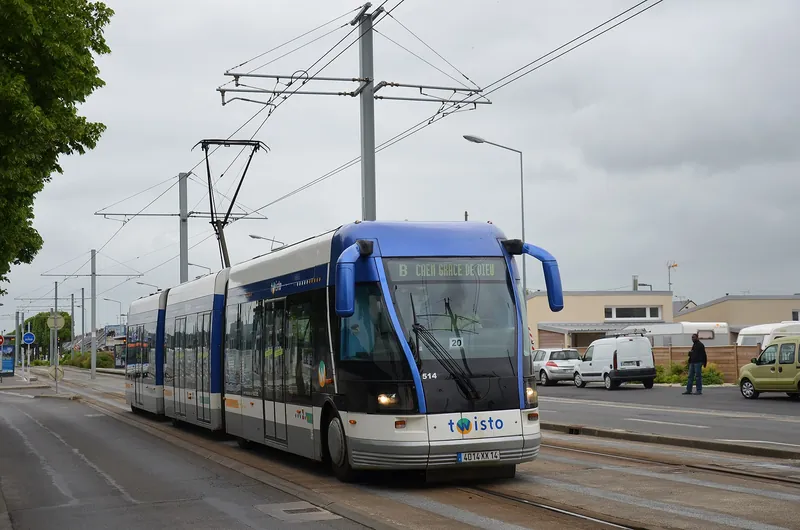
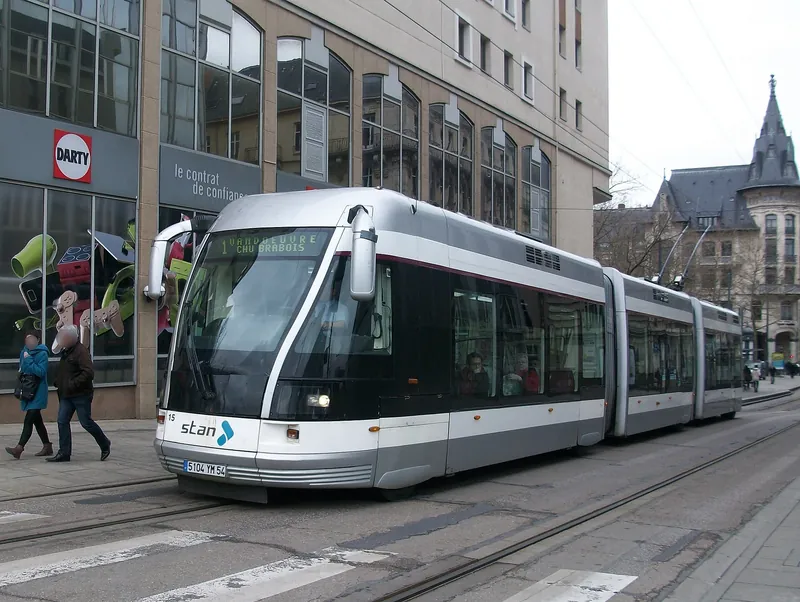
Nancy had 25 vehicles on an 11 km line, 60% of it guided. French government report, 2010 Caen had 24 vehicles on a 14.8 km network, all of it guided. French government report, 2010
Its guidance was a closed, one-maker design, so no other manufacturer’s vehicles could share the rail. French government report, 2010 With so few made, there were no savings of scale on maintenance or spare parts. French government report, 2010
By 2010 the government judged its reliability disappointing overall, with poor availability and high maintenance costs. French government report, 2010
The state had put more than 60 million euros of subsidies into the two networks. French government report, 2010
The 2010 report advised keeping the TVR running for at least ten more years with a full overhaul. Bombardier priced its modernisation programme at 740,000 euros a vehicle. French government report, 2010
Clermont-Ferrand chose a different tram on tyres, Lohr’s Translohr. The 2010 report said its guidance was well designed and reliable, but the TVR’s troubles had done its reputation no favours. French government report, 2010
By the time Nancy planned its replacement, Railway Gazette was calling the Bombardier TVR “now-discontinued”. Railway Gazette
Caen: back to rails
Caen stopped its TVR at the start of 2018, and work on a new tramway began. Caen la mer, 2019
Caen’s new tramway opened on Saturday 27 July 2019, replacing the tram on tyres with a tram on rails. Caen la mer, 2019
Caen la mer says the new tram carries 64,000 passengers a day, against 42,000 with the TVR. Caen la mer, 2019
Nancy: trolleybuses instead
Nancy had planned to turn the line into a steel-wheeled tramway: the plan was set out in December 2018, but the metropolitan council voted to suspend it on 11 February 2021. Railway Gazette
In the end, the same steep gradients that had led Nancy to the TVR meant it chose trolleybuses rather than a conventional tram. CBW magazine, 2023
Nancy’s TVR closed on Sunday 12 March 2023, and ordinary buses ran in its place while the route was rebuilt. CBW magazine, 2023
Nancy’s Line 1 reopened on Saturday 5 April 2025 with all-electric trolleybuses. Métropole du Grand Nancy
The new vehicles are HESS lighTram 25 DC trolleybuses. About 62% of the 9.78 km route has overhead wires, and batteries cover the rest. HESS AG
Grand Nancy’s own comparison: the new trolleybus carries up to 154 passengers (the old tram 136) and uses 2.4 kWh per kilometre (the old tram 4 kWh). Métropole du Grand Nancy Line 1 carries about 45,000 journeys a day. Métropole du Grand Nancy
Next: myths vs facts →